Genuine or fake Labubu: how to spot a counterfeit
By Léna, co-founder & Art Director at swap-iit
≈ 6 mins’ read
Fake Labubu figures are known in the community as ‘Lafufu’. They’ve become a real scourge: counterfeits are flooding AliExpress, some Vinted listings and Instagram, and some are so well made that they’re almost indistinguishable from the real ones. 😬
Good news: there are details that almost always give a fake away. Here’s how to tell a genuine Labubu from a fake, step by step. Spoiler: no single criterion is a 100 per cent guarantee, but taken together, they give you a fairly reliable answer.
Contents
- What is a ‘Lafufu’?
- Take a look at the figurine: the details that give it away
- Check the packaging
- Official Pop Mart safety features
- Price and seller
- The trick that saves the day: film your unboxing
- FAQ: genuine or fake Labubu
What is a ‘Lafufu’?
‘Lafufu’ is the little nickname given to counterfeit Labubu figures. Created by the Hong Kong artist Kasing Lung (his ‘The Monsters’ series, licensed by Pop Mart), Labubu has become so trendy that fakes have proliferated alongside the demand. Some are crude and downright funny; others are stunningly realistic. Hence the importance of knowing what to look out for.
Take a look at the figurine: the details that give it away
The 9-tooth test (the quickest test)
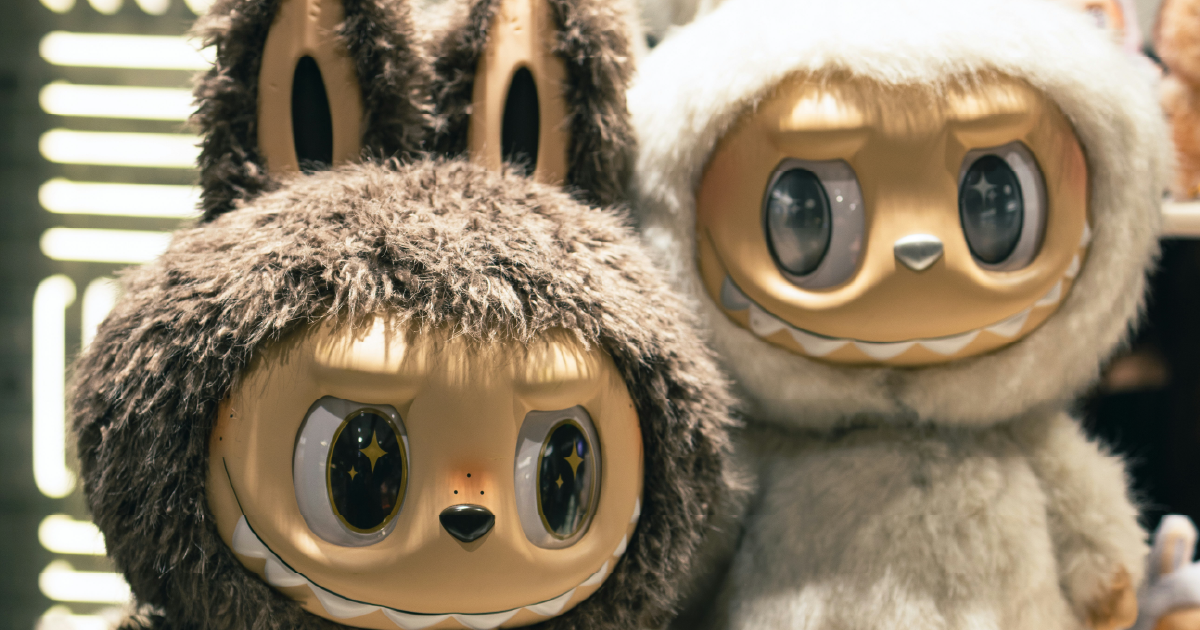
The classic sign: an authentic Labubu from The Monsters range has exactly nine teeth, sharp like little fangs. Any more, any fewer, or teeth that are too regular and perfectly aligned? That’s suspicious. On genuine ones, the teeth are a slightly cool off-white, of slightly uneven sizes, as if moulded naturally.
The eyes and the face
Genuine figures have sculpted, shiny, ‘lively’ eyes with moulded eyebrows. Fakes often have flat, painted, dull eyes, with pupils that are too large or poorly positioned. As for the complexion, the authentic face has a pale, matt peachy-beige tone; a shade that is too bright or too yellow is suspicious. Tip: always compare with the official photos on the Pop Mart website.
Materials and finishes
A genuine Labubu is made of high-quality, flexible vinyl, has crisp paintwork, and is a well-balanced figurine that stands upright. Fakes often give away their true nature with hard, cheap-looking plastic, traces of glue (especially around the face), paint that has run or is flaking, and sometimes a figure that won’t stand upright.
Check the packaging
The box
The official box has a matt finish, soft colours and text that is often raised (you can feel it under your finger). Fake boxes are often glossy, with colours that are too bright and blurred printing. A really telling detail: even the small icons (like the bin logo) are sometimes poorly reproduced, with corners that are too sharp rather than rounded.
What’s inside
In a genuine Labubu blind box, you’ll usually find: the figurine in a sealed aluminium pouch, a clearly printed character ID card, and a small sachet of desiccant with clear logos. If your ‘brand-new’ Labubu arrives in a simple plastic bag without a box… that’s a big red flag.
Official Pop Mart safety features
Since its 2024 releases, Pop Mart has stepped up its anti-counterfeiting efforts. Here are two key points to note.
The verification QR code
Recent series include a QR code (on the box and/or on the figure’s label). When you scan it, it should redirect you to an official Pop Mart verification site (for example, a domain such as fwsy.popmart.com), where you enter the code to confirm authenticity. If the scan takes you somewhere else, or if there is no code at all on a series that is supposed to have one, be wary. Please note: older (or discontinued) series may not have a QR code, so its absence is not proof of counterfeit status on its own.
The stamp under the foot
Pop Mart has also added an engraved mark and the artist’s name beneath the figure’s foot. A genuine item features this neatly engraved detail; a fake often omits it or reproduces it blurrily.
Price and seller
The simplest red flag: a price that’s too good to be true. If it’s being sold at a price well below market value, it’s rarely a bargain. The safest option is still to buy directly from Pop Mart (shops, app, verified official retailers).
On the secondary market, favour sellers who show genuine, detailed photos, have credible reviews, and are willing to show you the packaging and close-ups of the figure.
The trick that saves the day: film your unboxing
One of the best tips from the community: film your entire unboxing, from the sealed parcel right through to the figure being taken out of its box, making sure to clearly show the packaging and the anti-counterfeit code. This is your best evidence in the event of a dispute (a common scam involves placing a fake item in a genuine, resealed box). A two-minute video could save you a lot of hassle.
And what about swap-iit in all this?
Trust in authenticity has been one of swap-iit’s cornerstones right from the start. We’re working on an AI-assisted verification system to help spot fakes – not as some sort of magic guarantee, but as a real helping hand on top of all the precautions mentioned above. The idea is that you can swap your Labubu (and everything else) without feeling a knot in your stomach every time you make a transaction.
We’re launching in September 2026. The waitlist is open: the first 500 people to sign up will receive a lifetime Founder badge and priority access. 💛 And if you’re drowning in duplicate blind box figures, we’ve got an article for that too.
FAQ: genuine or fake Labubu
How many teeth does a genuine Labubu have?
Brand new, for the classic Labubu figures from The Monsters range. A different number, or teeth that are too perfectly aligned, is a common sign of a counterfeit.
How do you check a Labubu using the QR code?
Scan the QR code on the box or label: it should redirect you to an official Pop Mart verification site, where you enter the code to confirm authenticity. If it takes you to a different site, it’s suspicious.
What is a ‘Lafufu’?
This is the nickname given by the community to fake Labubu figures – the counterfeits that are circulating, particularly on online marketplaces and social media.
Does a very low price necessarily mean it’s a fake?
It’s not always the case, but it’s one of the most reliable indicators. A price well below market value should always set alarm bells ringing.
Do all the older Labubu series have a QR code?
No. Older or discontinued series may not have one. The absence of a QR code is therefore not, in itself, proof that it is a fake: cross-check it against the other criteria (teeth, material, packaging).
Not sure about a particular piece? The community’s go-to is to take a photo and compare it with the official Pop Mart images, or to ask a group of collectors for their opinion. There’s strength in numbers. 💛